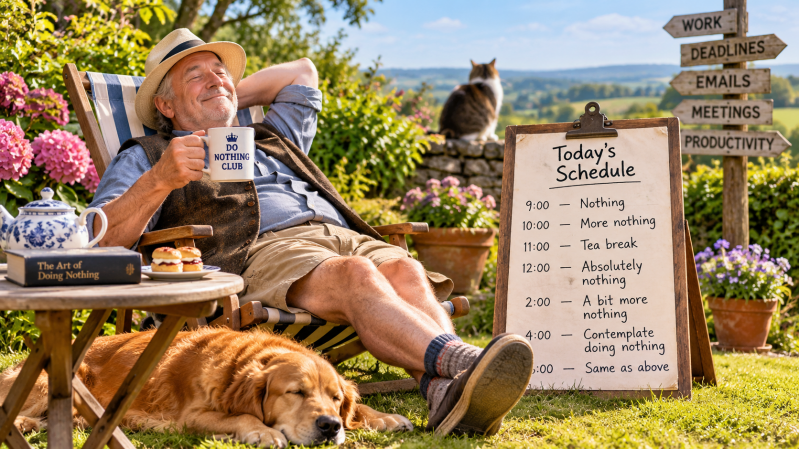
The Fine Art of Doing Absolutely Nothing
There was a time when doing absolutely nothing was considered a perfectly respectable pastime. You could sit in a chair, stare out of the window and contemplate the mysteries of the universe without anyone suggesting you needed a hobby.
Bing Crosby famously sang about being "busy doing nothing" in the 1949 film A Connecticut Yankee in King Arthur's Court. It was a wonderfully absurd idea then, and it seems even more appropriate today.
Perhaps the benefits of doing nothing deserve greater recognition. After all, why should every waking moment be devoted to achieving something?
When Did Doing Nothing Become a Crime?
Somewhere along the way, we developed the peculiar notion that being busy is a measure of personal worth.
Ask someone how they've been, and there's a reasonable chance they'll reply, "Busy!" It's almost a badge of honour, suggesting they're important, indispensable and possibly responsible for keeping the planet rotating.
Nobody proudly announces, "I've accomplished absolutely nothing this week, and I'm rather pleased with myself."
Yet why not?
We've become so accustomed to measuring our days by completed tasks that an afternoon without achievement can leave us feeling vaguely guilty.
This helps explain why rest is often mistaken for laziness. From the outside, the two can look remarkably similar. Both might involve a comfortable chair, a cup of tea and an apparent absence of movement.
But rest is a genuine human requirement, not a character defect.
Even the most enthusiastic workaholic needs an occasional opportunity to stop.
Preferably before the batteries fall out.
The Lost Art of Chilling Out
In the parlance of the 1960s, we might have called it chilling out. A wonderfully uncomplicated expression for something modern society seems determined to complicate.
There is something deliciously rebellious about having absolutely nothing planned.
No appointments. No deadlines. No urgent emails demanding attention from someone who has apparently forgotten how telephones work.
Just time.
Psychologists recognise the psychological value of unstructured time, which can provide opportunities for reflection, relaxation and spontaneous thought.
Indeed, research discussed in <why doing nothing is good for your brain suggests that periods of quiet rest may help the brain consolidate recently acquired memories. The evidence is still developing, but it gives scientific credibility to the humble art of taking a break.
Those of a more spiritual inclination might recognise similarities with Zen meditation, although meditation generally involves deliberate attention rather than simply doing nothing.
Personally, I've never found attempting to stop my brain from thinking particularly interesting. Indeed, I've discovered that achieving a completely empty mind is practically impossible.
The harder I try not to think, the more my brain seems determined to find something worth thinking about.
Perhaps the secret isn't to stop thinking altogether, but to stop insisting that every thought must lead somewhere useful.
And occasionally, the kitchen cupboards can survive an entire Sunday afternoon without being reorganised.
The Tyranny of Being Productive
Modern society has developed an extraordinary talent for turning almost everything into a measurable achievement.
We count steps, monitor sleep, track calories and congratulate ourselves when an electronic device announces that we've stood up.
Apparently, standing is now an accomplishment.
There's nothing inherently wrong with setting goals or enjoying productive activity. Problems arise when productivity becomes an obligation rather than a choice.
Consider how constant productivity affects our wellbeing. Continually feeling pressured to achieve something can contribute to stress and make genuine relaxation surprisingly difficult.
For someone living with multiple sclerosis, this expectation can become particularly absurd.
There are days when energy is a scarce commodity, and deciding how to spend it requires more thought than the Chancellor's annual budget.
And the pressure isn't always visible. As I've explored in <the hidden stress of living with MS, ordinary activities can carry demands that other people may never notice.
On such occasions, doing nothing may be a sensible response to physical limitations rather than a failure of ambition.
But this isn't exclusively a disability issue.
Everyone has limits, even if some people appear determined to ignore theirs until their bodies submit a formal complaint.
Living with MS can also change our priorities and perceptions, something explored in when MS changes how we see the world. Perhaps slowing down occasionally allows us to notice things we might otherwise overlook.
Giving Inspiration Room to Breathe
One of the more intriguing aspects of inactivity is that the brain doesn't simply switch off when we stop concentrating.
During quiet wakefulness, networks involved in internally directed thought remain active. These processes are associated with remembering experiences, imagining possibilities and reflecting on ourselves.
This helps explain the importance of allowing the mind to wander.
For a creative mind, stepping away from a problem can be rather like wiping a blackboard clean. The information hasn't disappeared, but there's suddenly room for a different arrangement of ideas.
Have you ever struggled with a problem, abandoned it in frustration and discovered the answer while washing the dishes?
It's not necessarily magic, although it can feel suspiciously like it.
This is particularly relevant when creativity hits a wall. Sometimes, pushing harder isn't the answer. Giving an idea time to settle can be more useful than wrestling it into submission.
The same principle can apply to learning something new. Whether writing, painting or playing an instrument, progress doesn't always arrive through relentless effort. There's much to be said for learning for joy through slow musical practice, where enjoyment matters as much as achievement.
Throughout history, thinkers have valued contemplation. But I wouldn't suggest that earlier generations necessarily enjoyed easier lives or more leisure. Many worked extraordinarily hard.
What matters is that some of our greatest ideas have emerged from periods of reflection rather than relentless activity.
Naturally, sitting in an armchair doesn't guarantee a brilliant invention by teatime.
If it did, I'd have patented several revolutionary devices by now.
Conclusion: More Haste, Less Speed
My grandmother frequently reminded me that "More haste, less speed." It's an old saying, but one that seems increasingly appropriate in our permanently hurried world.
Perhaps the benefits of doing nothing are less about inactivity itself and more about giving ourselves permission to exist without constantly proving our usefulness.
Rest needn't be earned through exhaustion. Nor must every quiet moment become an opportunity for self-improvement.
Sometimes the most sensible thing we can do is sit down, enjoy a cup of tea and accomplish absolutely nothing.
And if anyone asks what you've achieved today, simply reply:
"Absolutely nothing. And I did it exceptionally well."
Create Your Own Website With Webador