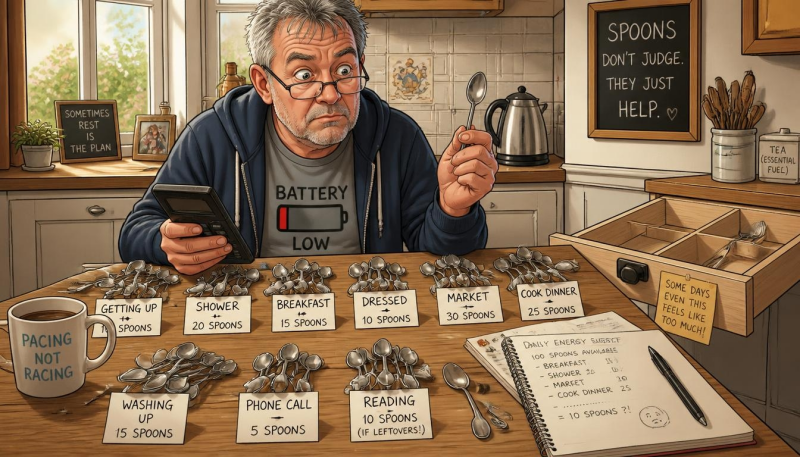
being a spoon counter
Multiple sclerosis has a peculiar talent for turning ordinary life into an exercise in mathematics. Suddenly, getting dressed, making breakfast and taking a shower require the sort of calculations normally reserved for accountants. Welcome to being a spoon counter, where energy is precious, the budget is unpredictable and nobody tells you how many spoons you've got until you've spent them.
Welcome to the Cutlery Accounting Department
MS feels like being a spoon counter because even the simplest activities can come with an unexpected energy bill.
Most people wake up and get on with their day. They don't generally calculate whether brushing their teeth will leave enough energy to make breakfast.
But when fatigue becomes part of everyday life, those decisions can take on ridiculous importance.
Shower this morning? Lovely idea.
Get dressed afterwards? Possibly ambitious.
Make breakfast as well? Steady on, we're not training for the Olympics.
The problem isn't laziness or a lack of enthusiasm. It's that your available energy doesn't always match your plans.
And unlike your bank account, you can't simply check the balance before spending.
To make matters more interesting, MS can also affect your coordination and balance. As I explored in I'm Not Drunk, I Have Multiple Sclerosis – Honest!, even moving around can become an adventure nobody actually signed up for.
What Exactly Is a Spoon Counter?
Understanding spoon theory in everyday life begins with a simple idea: imagine starting each day with a limited number of spoons.
Each spoon represents a portion of the energy available for everyday activities.
Getting dressed might cost one. Preparing a meal could cost another. A trip to the shops might consume several.
Christine Miserandino introduced the idea in a 2003 essay about a conversation in a diner. Asked what living with lupus felt like, she gathered spoons to show her friend how ordinary tasks could exhaust a limited allowance. The metaphor later spread to other chronic conditions, including MS.
Of course, nobody actually issues you a cutlery allowance each morning.
And if they did, MS would probably lose the paperwork.
People who identify with this experience sometimes call themselves 'spoonies'. The spoons are a metaphor, not a scientific measurement or a treatment. Their value lies in helping explain why activities that seem effortless to one person can be exhausting to another.
For a more detailed explanation of the metaphor and its origins, my companion article on My MS is Me explores the meaning and origin of the term spoonie.
The Great Spoon Budget Disaster

The Great Spoon Disaster
Managing daily activities with an energy budget sounds wonderfully sensible.
Unfortunately, MS isn't always interested in sensible arrangements.
Imagine waking up with what feels like ten spoons.
You spend two getting washed and dressed, another preparing breakfast and three tackling the housework.
That leaves four.
Excellent. You're practically wealthy.
Then somebody suggests a spontaneous afternoon outing.
Suddenly, your carefully balanced accounts collapse.
And sometimes the calculations are wrong from the beginning. What felt like ten spoons turns out to have been six, with another three apparently borrowed from tomorrow. On a rare good day, the temptation is to tackle everything you've postponed. The following day may bring a reminder that enthusiasm isn't an unlimited overdraft.
Living with limited energy and chronic illness means learning that even the best plans may need changing.
It's budgeting with an accountant who keeps moving the decimal point.
When Counting Spoons Stops Being Funny
There is, however, a more serious side to all this arithmetic.
The emotional challenges of counting spoons can be harder to explain than the physical exhaustion itself.
It's frustrating to turn down an invitation because you've already used your available energy.
It's disappointing to abandon something enjoyable because an ordinary morning has left you exhausted.
And it can be especially difficult when other people don't understand why yesterday's perfectly manageable activity feels impossible today. Cancelling a plan doesn't mean you didn't want to go. It may mean the journey, the noise and the effort of being sociable have become more than your remaining spoons can cover.
The unpredictability is part of the problem.
Sometimes you can manage more than expected. Sometimes considerably less.
And fatigue isn't always confined to physical activities. Mental effort can consume precious energy too. Even something enjoyable, such as learning a language while coping with MS brain fog, may require a little creative spoon budgeting.
Having to make those choices repeatedly can leave you feeling as though your life is being organised by a committee of particularly unhelpful teaspoons.
Humour doesn't remove the frustration, but occasionally it makes the situation easier to describe.
Not Every Spoon Needs Spending

Save your Spoons
One of the stranger lessons of living with MS is that having some energy available doesn't mean you're obliged to use every last drop.
There will always be another job waiting, another invitation to consider or another household task demanding attention.
But rest isn't necessarily wasted time.
Sometimes leaving something unfinished is a perfectly reasonable decision. Nor does an unexpected burst of energy have to become a frantic attempt to catch up on every neglected job.
And sometimes the most productive thing you can do is absolutely nothing.
That doesn't mean abandoning activities that keep your mind engaged. In fact, learning something new can help you work through brain fog, provided you're realistic about the energy involved.
There's also an important distinction between feeling exhausted and experiencing actual muscle weakness. My article on muscle fatigue versus muscle weakness in MS explores why these two experiences shouldn't automatically be treated as the same thing.
That might sound ridiculous to someone whose energy supply behaves predictably.
For a spoon counter, it can make perfect sense.
Conclusion: MS feels like being a spoon counter
MS feels like being a spoon counter because everyday life can involve constant decisions about what deserves your limited energy.
Some days the calculations work. Other days the numbers make absolutely no sense.
Spoon theory doesn't explain every aspect of MS fatigue, and it certainly doesn't provide a cure. What it offers is a memorable way of describing an experience that can otherwise be difficult to communicate.
Perhaps the trick isn't becoming a better accountant.
Perhaps it's learning that you don't have to spend every spoon just because you've got one.
And if anybody asks why the washing-up hasn't been done?
Tell them you've run out of cutlery.
For more light-hearted reflections on the unpredictable realities of living with MS, explore our post collection.
Create Your Own Website With Webador